Asparagus crowns and rhubarb by mail: choosing varieties, planting depth and the years before the first harvest
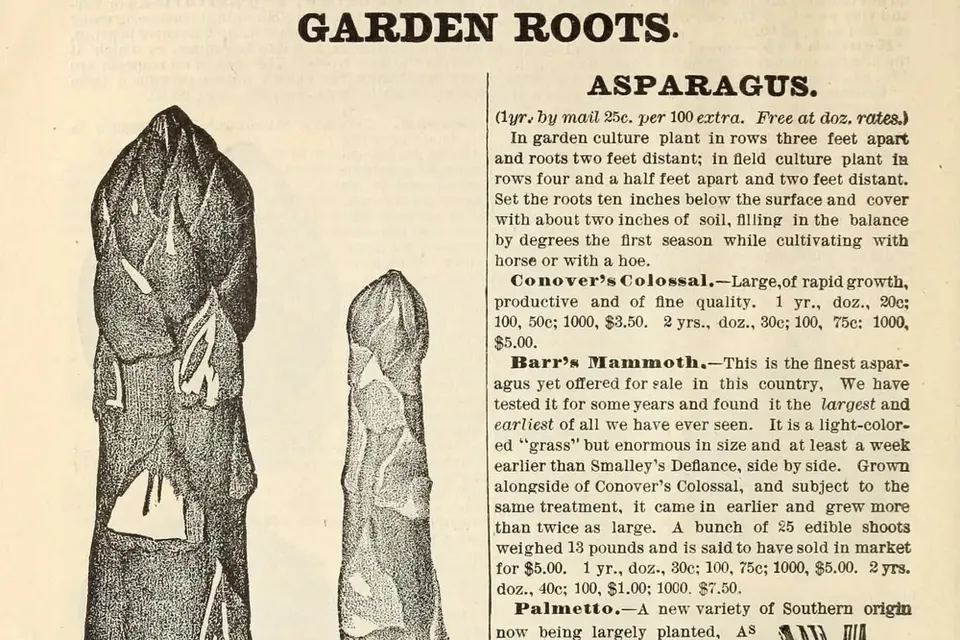
Most of what a vegetable catalog sells is gone by the end of the season. Asparagus and rhubarb are the exceptions. Both are perennials that stay in the same spot for years, both are usually sold as dormant roots rather than seed, and both ask you to wait before you pick anything. Ordering them well is mostly about choosing the right place and the right kind before the box arrives, because moving an established bed later is hard work.
Why these two arrive as roots
You can grow asparagus from seed, but University of Minnesota Extension notes that it is typically planted as crowns: one-year-old root systems with buds on top, dug while dormant. Starting from crowns saves a year of nursery work in your own garden.
Rhubarb is different again. University of Wisconsin–Madison Extension explains that it is generally propagated by division, and that stalk color varies, especially in seed-grown plants. If you want the deep red stalks pictured in a catalog, a named variety sold as a crown or division is the only way to be sure of getting it. Seed is cheap, but what comes up is a lottery.
Both therefore ship the way other dormant perennials do: bare, in damp packing, in early spring. Our guide to bare-root plants by mail covers the general rules for that kind of parcel; what follows is specific to these two crops.
Choosing asparagus
The main choice in an asparagus listing is between all-male hybrids and older open-pollinated varieties. Asparagus plants are either male or female. Female plants put energy into red berries, and the seeds that fall from them come up as seedlings in the bed. Hybrids bred to be male, or almost all male, avoid both.
Minnesota names Jersey Giant as a hybrid with only male flowers. It also notes that Jersey Knight and Jersey Supreme, long sold alongside it, have been discontinued, so treat older catalog recommendations with care and check what is actually in stock. Its other recommended varieties are Millennium, Mary Washington, Viking KB-3 and Purple Passion; the listing should tell you whether each one is all-male.
A planting can produce for fifteen years or more, according to Minnesota, which makes the variety choice worth a little research. Catalogs also offer crowns by age. A late nineteenth-century catalog, J. T. Lovett's for autumn 1891, already sold one-year and two-year roots at different prices; the planting advice below assumes one-year crowns, which Minnesota describes as the usual starting point.
Choosing rhubarb
Rhubarb stalks come in red, green or speckled pink. Wisconsin points out that most people prefer red, but that green types are generally more productive, and that a red stalk is no guarantee of sweetness. Its list of recommended varieties includes Canada Red, Cherry Red, Crimson Red, MacDonald, Valentine and the speckled Victoria.
Most households need only a few plants: each one is large, Wisconsin's spacing is about three feet apart, and you will harvest the same crowns for years. Order fewer and give them better soil.
Timing your order
Both crops ship and go into the ground in early spring, while still dormant. Wisconsin suggests planting rhubarb about four to six weeks before your average last frost. Minnesota plants asparagus crowns between early May and early June, which is the right window for that state; gardeners further south plant earlier. A nursery that ships by hardiness zone will usually time the parcel for you, which is one more reason to give it the correct address and zone. Our guide to hardiness zones and shipping seasons explains how those calendars work.
Prepare the bed before the box arrives. Both crops stay put for years, so perennial weeds need to be cleared first: once the crowns are in, deep digging around them is no longer possible. Minnesota recommends a soil test and a pH between 6.5 and 7.0 for asparagus; Wisconsin wants rhubarb in full sun, in fertile, well-drained soil rich in organic matter, and notes that raised beds improve drainage and help prevent crown rot.
When the crowns arrive
- Open the box on arrival. Roots should be firm and slightly damp, not slimy, moldy or dried into brittle strings.
- Minnesota stresses that asparagus crowns must not dry out before they are covered. If you cannot plant the same day, keep them cool and in their damp packing, and plant as soon as you can.
- Count the rhubarb buds. Each crown or division needs at least one strong bud, the same rule Wisconsin gives for dividing your own plants later.
- Photograph anything that looks wrong and report it straight away. Our checklist for when your plants arrive covers what to note for a replacement claim.
Planting asparagus in a trench
Asparagus goes in deeper than most new gardeners expect. Minnesota's method:
- Dig a trench 6 to 12 inches deep: 6 to 8 inches in heavy clay, 10 to 12 inches in very sandy soil. Allow about a foot of trench per crown, and keep rows at least 3 feet apart.
- Set the crowns in the bottom with their buds about 12 inches apart. Minnesota describes spreading the roots out like an octopus as an outdated practice; laying crowns head to toe along the trench is enough.
- Cover with only 2 to 3 inches of soil and water straight away.
- As the spears grow sturdy and several inches tall, fill the trench in gradually, without dropping large dry clods on them.
The method has hardly changed. The 1891 Lovett catalog told its customers to set the roots ten inches deep, cover them with about two inches of soil and fill in the rest during the first season.
Planting rhubarb
Rhubarb goes in shallow by comparison. Wisconsin advises setting each crown or division so the buds sit about 2 inches below the soil surface, with plants about 3 feet apart. Lovett's catalog said about an inch below the surface, with plants three feet apart in rows four feet apart: different sources give slightly different depths, but all of them keep the buds close to the top. Remove any flower stalks as soon as they appear, so the plant puts its strength into leaves and roots.
The waiting years
| Asparagus (University of Minnesota) | Rhubarb (University of Wisconsin) | |
|---|---|---|
| First year | No harvest | No harvest, do not pull leaves |
| Second year | Pick spears 6 to 8 inches long, for about two weeks only, if the plants are healthy | Wait until the second or third year before the first harvest |
| Established bed | About 6 to 8 weeks of picking; in Minnesota, stop around the end of June | Take no more than one-third of the leaves in a year |
Minnesota adds that some gardeners skip the second-year harvest altogether and start in the third. The reason is the same for both crops: the leaves and ferns that grow after you stop picking feed the roots for the following spring. A bed picked too hard too early produces thin spears or stalks for years.
For rhubarb, Wisconsin's advice is to harvest firm, crisp stalks 8 to 15 inches long by twisting them off at the soil line, then cutting off the leaf blade. The leaves contain a toxic amount of oxalic acid and should never be eaten; they can go on the compost heap. Wisconsin also advises against harvesting after a hard late-spring freeze, when stalk quality suffers.
Keeping the bed going
For asparagus, Minnesota recommends retesting the soil every three years and fertilizing only if the test calls for it, weeding by hand or by shallow cultivation outside the harvest season, and watching for asparagus beetles, which scar spears and can bend them into a shepherd's crook. Rhubarb clumps grow crowded with time: Wisconsin suggests dividing and resetting them every fourth or fifth year, each piece with at least one strong bud, which is also how a single good mail-order crown can turn into a row.
Because both crops occupy their ground for so long, they belong in your plan before anything else. Our guide to planning a vegetable garden from catalogs suggests keeping perennials like these in a permanent spot, away from the beds you dig every year.
Order once, plant carefully, then wait: the first year's harvest from an asparagus or rhubarb bed is a stronger root.
Sources
- University of Minnesota Extension, Growing asparagus in home gardens (crowns, varieties, soil pH, trench depth and spacing, harvest schedule, bed care).
- University of Wisconsin–Madison Extension, Division of Extension Horticulture, Rhubarb, Rheum rhabarbarum (propagation, planting depth and spacing, varieties, harvest, toxicity of the leaves, division).
- J. T. Lovett Company, Lovett's illustrated catalogue of fruit and ornamental trees and plants for the autumn of 1891, page 46, “Garden roots”, Henry G. Gilbert Nursery and Seed Trade Catalog Collection, Biodiversity Heritage Library.
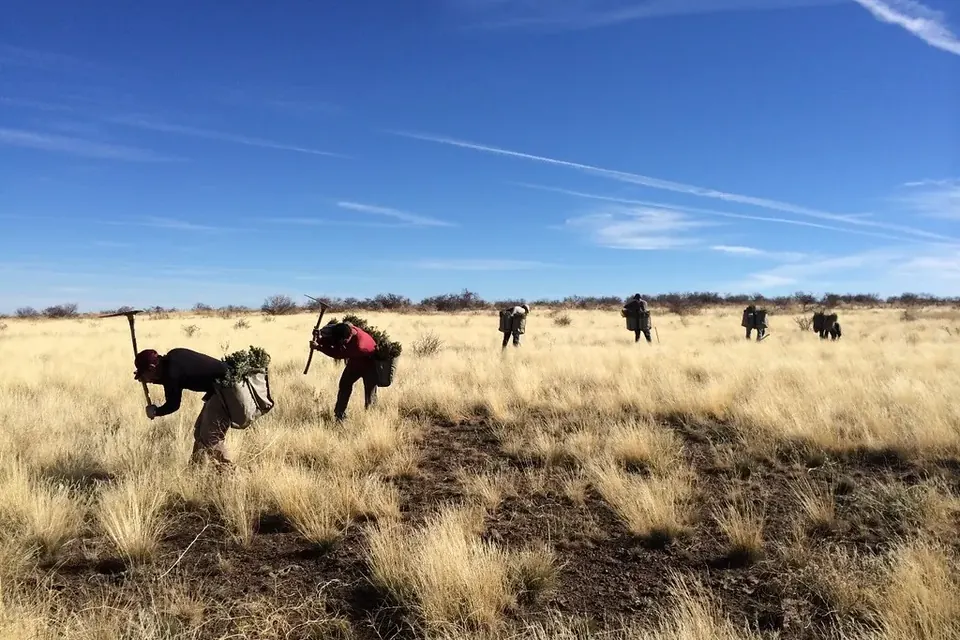 Ordering & arrival
Bare-root plants by mail
Dormant roots, no soil: timing, soaking, heeling in and planting right.
 Growing what arrives
Seed potatoes by mail
Certified tubers, mealy or waxy types, cutting seed pieces, planting depth, hilling and storage.
 Growing what arrives
Onion sets and plants by mail
Sets, bundled plants or seed, day length and latitude, bolting, spacing, curing and storage.